

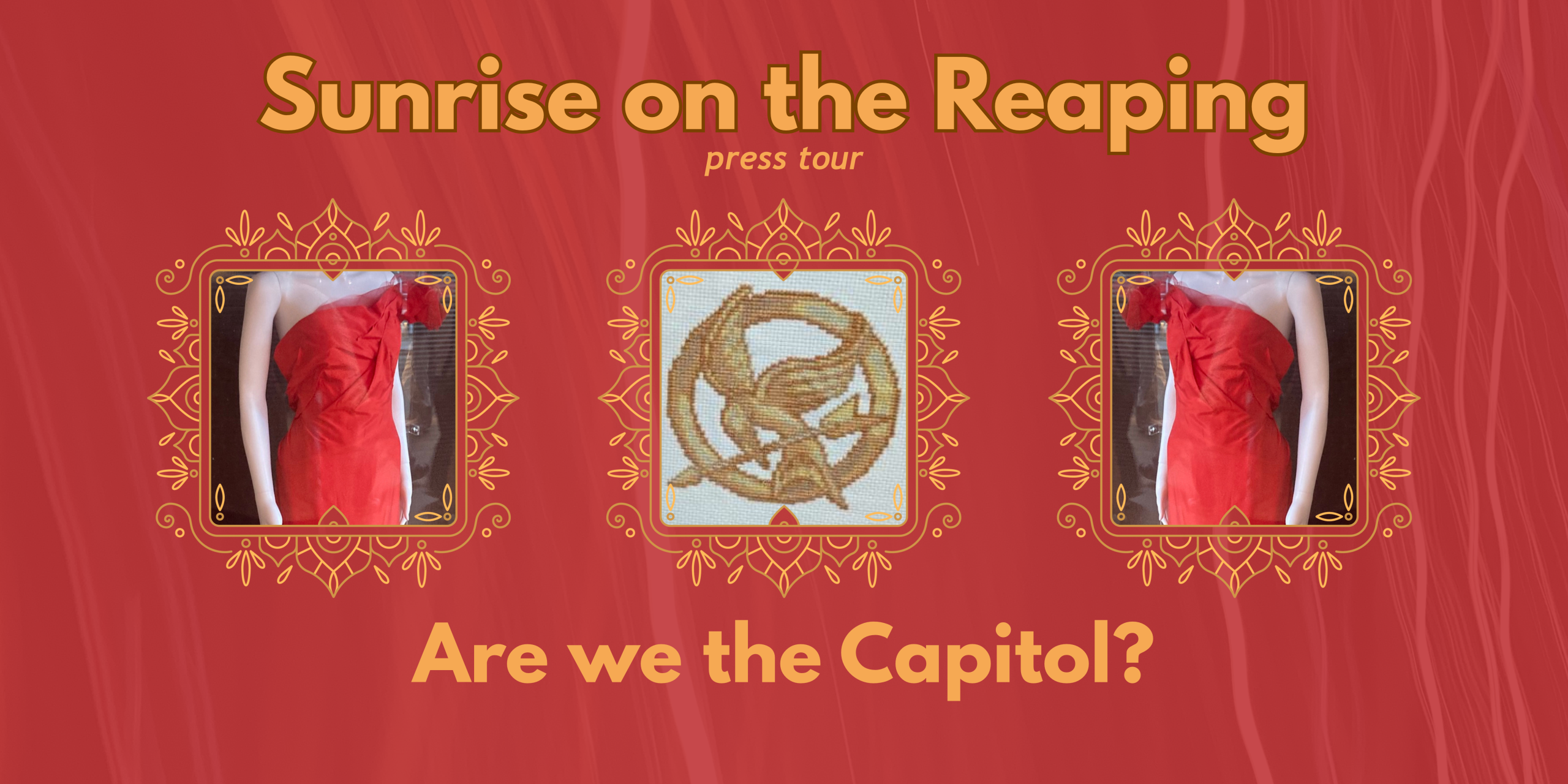
Since the release of Sunrise on the Reaping as the latest book in The Hunger Games franchise, the film’s promotions for its release in November 2026 have been subject to controversy. The franchise has always suggested that the line between violence and entertainment is blurred, a series where teenagers are forced to fight to the death in an arena, turned into a glorified TV show for the enjoyment of “the Capitol.” The question around the latest press tour is, “are we [the consumer] simply the Capitol?”
The film’s promotion has been largely commercial, partnering with brands to sell makeup, jewellery, clothing etc. Fans have pointed out the similarities between this and the propaganda surrounding the Games within the books, one controversy being the Paris Fashion Week promotions. Occurring alongside a time of protests and police brutality in France, fans have made comparisons between this and the Victory Tour in Catching Fire where rebellion and mistreatment are covered up by touring and promotion. A particularly controversial element has been the clothing choice, including Katniss’s wedding dress which began as a symbol of propaganda, worn during Paris Fashion Week by Mckenna Grace (playing Maysilee Donner). Fans have deliberated whether this was made in poor taste due to the costume’s initial symbolism or whether Grace is paying homage to the original trilogy. On the actress’s Instagram, she stated, “I wanted to pay homage to Katniss, and this dress is so iconic, although the meaning of the look is not lost on me,” and has since worn a variety of outfits paying homage to different characters and aspects of the series. Clothing and costume have always played a central role in The Hunger Games, and this is especially relevant with Grace’s character who takes fashion and elegance “back” from those in power, similar to how the wedding dress was transformed from a symbol of propaganda into a symbol of revolution within the books. The press tour does resemble certain Capitol aesthetics, but is this a way of “taking it back” or wilful ignorance?
Despite the criticisms, Lionsgate and Suzanne Collins (author of The Hunger Games) have partnered with World Food Program USA to send meals to one million families facing hunger worldwide through the film’s profits. Considering the themes of starvation and poverty in the franchise, Collins’ message is not only being shared but put into action. Essentially, entertainment is being used to create positive change as opposed to justifying violence.
There is a fine line between fiction and reality; it is inevitable that these controversies will crop up in relation to the series, with propaganda being one of the central themes within Sunrise on the Reaping. Is the film’s promotion a clever choice which reflects the issues of this, or a mistake which inadvertently promotes the same messages it claims to dispute? I think it is effectively impossible to promote the film without falling into traps of what the books criticise. Evidently, engaging with fandom culture is not the same as the Capitol watching real children kill for entertainment, but in a current climate of world hunger, violence, war and propaganda, the similarities are there.
Fans (myself included) are excited to see a book they care about come to life, and overall, I think it is where the proceeds go, and the real-world issues the film and its press tour acknowledge, which are the most telling about where it stands on this “line.”
Credits : Designed by Jack Oastler & Edited by Adam Affandy
