

To mark the opening of COP31 in Antalya, Turkey, the World Meteorological Organization (WMO) published a report estimating that 2026 will be one of four warmers year on record.
“We have entered a new age of climate extremes. A supersized El Niño is colliding with a planet already superheated by manmade climate change,” said the United Nations (UN) Secretary-General António Guterres, reacting to the report. “Leaders must get serious”.
What Is El Niño?
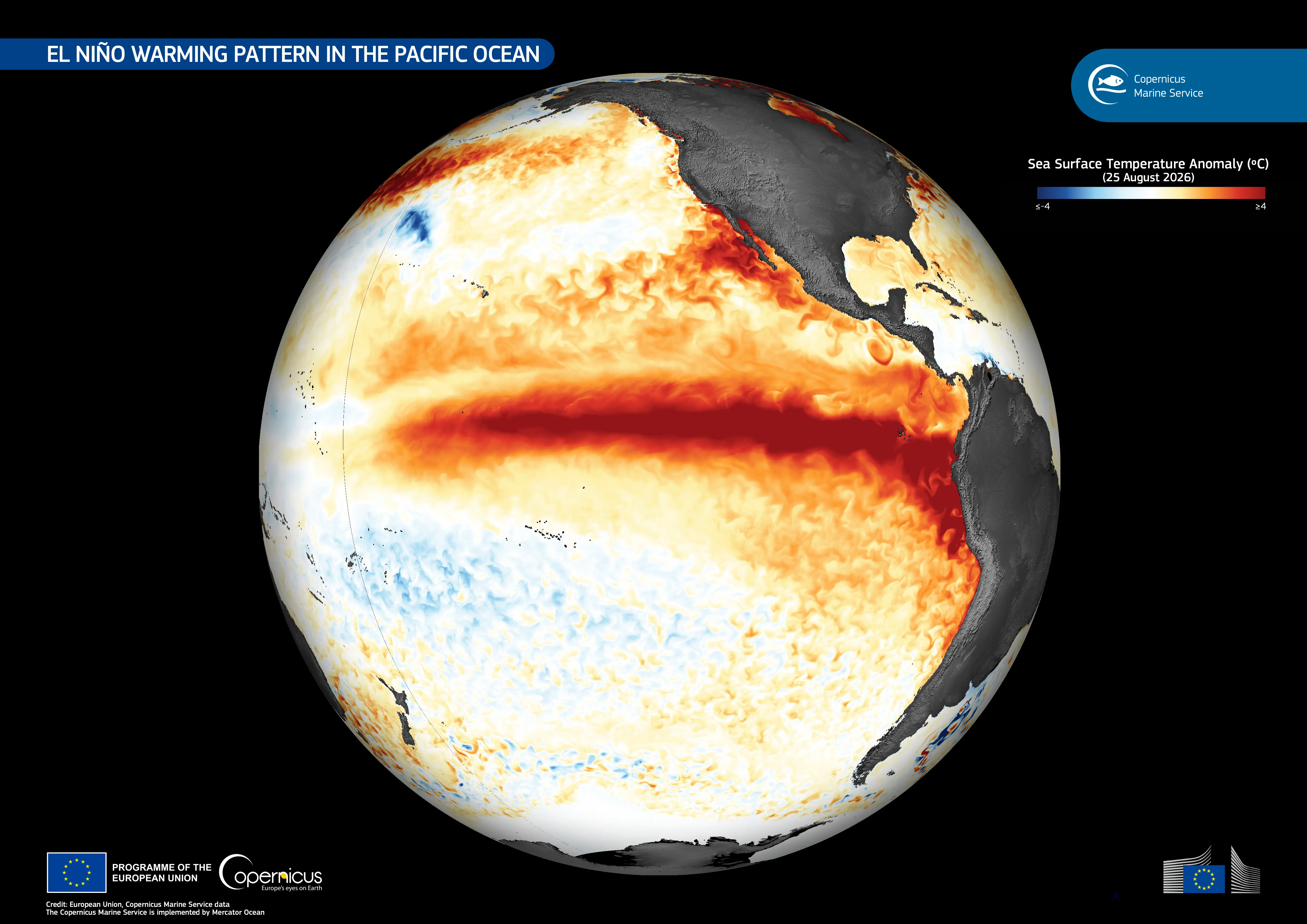
El Niño is part of a natural climatic phenomenon known as the ‘El Niño-Southern Oscillation’, it comprises two opposing extreme phases: the warm phase, known as El Niño, and the cold phase, known as La Niña.
El Niño is characterised by abnormally high sea surface temperatures in the central and eastern Pacific. Occurring around Christmas, the name was given by Peruvian fishermen and sailors who, having noticed a warm current associated with a decline in fish catches, named it ‘El Niño’ (‘the Christ Child’).
The WMO’s September El Niño/La Niña bulletin confirmed a probability of nearly 100% that the El Niño phenomenon will persist from November 2026 to February 2027. Furthermore, the Global Seasonal Climate Update, issued on 21 October, indicated that El Niño is expected to intensify further between November 2026 and January 2027, peaking around December 2026.
What Does the Report Say?
The report highlights that the past four years average temperature have been the warmest since preindustrial time (1.5°C above). Greenhouse gas levels increased by 53% since 1750, a new record in 2025. Sea level rise has reached a record high in 2026, Antarctic sea ice reached its third-lowest annual maximum, and glaciers lost more than 400 gigatonnes the year before.
The WMO points out that extreme events have affected lives, undermined food security, deepened poverty and contributed to displacement across multiple regions. Previously, the UN body had stated drought and heavy rainfall caused by El Niño can exacerbate famine and facilitate the spread of preventable diseases, as they are accompanied by water supply problems. Smoke from forest fires and injuries also have health implications. They have identified malnutrition, cholera, malaria and zoonotic diseases as proven risks, although it does not confirm that every country will experience the same conditions.
Who Is Taking Measures?
The WMO publishes reports in collaboration with the International Research Institute for Climate and Society. These seasonal forecasts aim to provide tailored tools for government decision-makers and climate-sensitive sectors. “This El Niño is a test. We have the science. We have advance warning. And we still have time to act,” said the WMO Secretary-General Celeste Saulo at the United Nations General Assembly in New York on 23 September 2026.
The World Health Organisation (WHO) has classified El Niño as a public health emergency for the first time. It confirms that the current El Niño episode could reach unprecedented intensity. In the epicentre of El Niño, the tropical Pacific, temperatures could exceed the average by 3.8 °C between November 2026 and January 2027.
The UN Central Emergency Response Fund has allocated 20 million US dollars to five affected countries: Guatemala, Somalia, Afghanistan, the Philippines and Mozambique, and could release up to 100 million US dollars for collective preventive measures in high-risk countries.
Humanitarian non-governmental organisations are also taking action. The International Rescue Committee, founded in 1933, combines local knowledge with scientific forecasts to assist vulnerable communities, and will step up its efforts before El Niño reaches its peak.
Future Prospects
Eleven years on from COP21, at which member states adopted the Paris Agreement, COP31 is expected to adopt new resolutions. The Paris Agreement’s central aim is to limit global warming to 1.5 °C by 2050. According to the United Nations Environment Programme, the most favourable scenario would limit global warming to 1.7 °C or 1.8 °C by 2050, a goal that requires, above all, a 6% annual reduction in greenhouse gas emissions between now and 2035.
There is, however, some positive news. A new study by the Global Carbon Project, published on 10 November 2026, expects global carbon emissions from fossil fuels to fall by 0.4% in 2026.
This is a positive first sign for the efforts needed to curb global warming.
Credits : Banner from Unsplash